
Hunter: Spending plan prioritizes families most devastated by COVID-19
- Details
- Category: Uncategorised
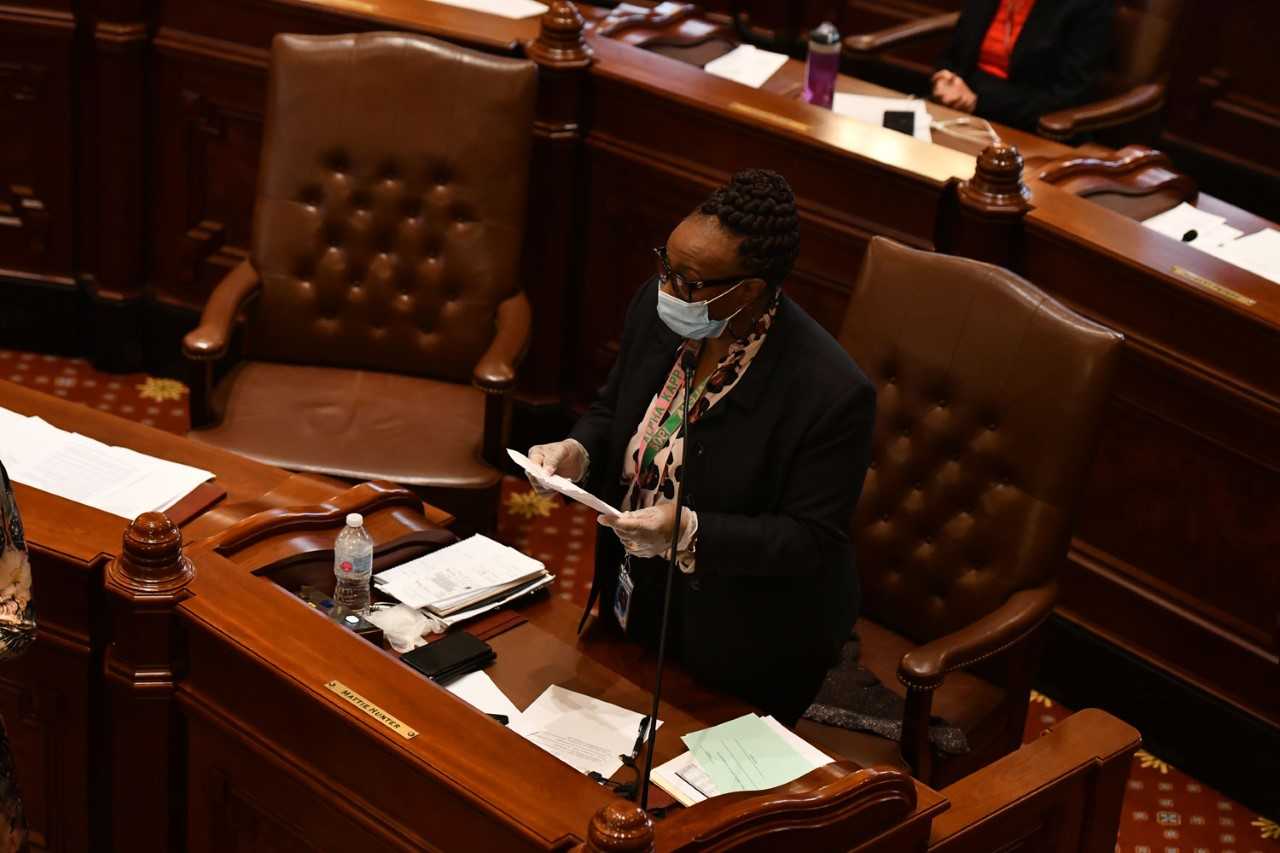
SPRINGFIELD – Following the passage of the state’s next budget out of the Illinois Senate, State Senator Mattie Hunter (D-Chicago) issued the following statement:
“Illinoisans, especially in my community, are seeing their own livelihoods and the health of their loved ones diminish in the midst of this pandemic. Today, we passed a budget that prioritizes those families above all else.
“We strengthened our investment in programs that allow seniors to access essential services and stay in their homes, out of harm’s way. We provided additional support to help small businesses in our most underserved communities keep their doors open and recoup their losses. Finally, with significantly increased funding for Medicaid and community health centers, we’re one step closer to closing the health disparities that continue to plague African-American communities.”
The budget package expands funding for the Community Care Program and the Home Services Program – programs that ultimately help vulnerable senior citizens and Illinoisans with disabilities stay in their homes who would otherwise have to be in assisted living, which significantly increases their risk of contracting COVID-19. Similarly, with the help of federal funding, the state’s Home Delivered Meals Program will nearly double its capacity for the upcoming year.
In addition to approving a budget, the legislature passed legislation to enact the Coronavirus Urgent Remediation Emergency (CURE) Act to provide support through grant programs to support public health businesses, and residents. This program will deliver more than $3 billion to support long-term care facilities, small businesses, local health centers, rent and mortgage assistance programs, and medical assistance providers.
The spending plan sets aside $600 million to fund grants for businesses impacted by COVID-19, with money specifically set aside for daycare providers.
Also included in the budget is $30 million for additional mental health and substance abuse programs for people effected by COVID-19.
Hunter reminds Chicago students and educators to use state’s new Wi-Fi hotspot map
- Details
- Category: Uncategorised
 CHICAGO – In light of Gov. JB Pritzker’s recent announcement that Illinois schools will remain closed for the remainder of the academic year, State Senator Mattie Hunter (D-Chicago) is encouraging Chicago’s remote learners and educators to use the state’s new drive-up Wi-Fi hotspot map to find free wireless internet locations.
“Lack of internet access for urban families is one of many significant problems underscored by COVID-19,” Hunter said. “While it will take long-term solutions to close this divide, this interactive map is a great tool for the thousands of students whose academic progress has been thrown off balance in the middle of the school year.”
Designed to assist students at every level who don’t have consistent internet access in their homes, the interactive map provides drive-up Wi-Fi locations throughout the state and specific log-in instructions for visitors. Students and their parents or guardians should continue to practice social distancing by remaining in their cars while using the hotspots.
As of May 11, the Wi-Fi map has 380 hotspots students can use to complete coursework.
“Low-income students in our community already face problems that hinder their educational outcomes,” Hunter said. “It’s important we do everything we can to help keep student support networks strong, in addition to keeping them on track academically.”
To find a hotspot near you, click here.
Hunter: Full and accurate census count in Chicago is more important than ever
- Details
- Category: Uncategorised
 CHICAGO – State Senator Mattie Hunter (D-Chicago) is encouraging Chicago residents, particularly in underserved communities, to help secure their fair share of federal funding and protect their voice in government by completing the 2020 Census.
“Many of the neighborhoods I represent recorded some of the lowest response rates in Chicago during the 2010 Census. Those same communities continue to face long-standing racial disparities in health-care access and quality and have been among the hardest hit by COVID-19,” Hunter said. “With health-care dollars on the line, a full and accurate census count is more important than ever.”
In 2010, the city of Chicago had a final response rate of 66%. So far this year, the city’s response rate is down, currently only at 50.1%.
Although online is the quickest way to fill out the questionnaire, there are three ways you can respond: online, by phone or by mail. Hunter also pointed out that higher self-response rates mean fewer individuals are likely to receive visits from census surveyors to be counted in-person. This year, census surveyors are putting the health of themselves and their families at risk from COVID-19.
“Completing the census is easier than ever before,” Hunter said. “By taking 10 minutes to complete the questionnaire, you’re bringing more than $18,000 per person to your community over the next decade. This money supports our public schools, economic opportunity, housing, family programs, and so many more vital aspects of our community.”
If you haven’t filled out your census questionnaire yet, you can visit 2020census.gov, where you can find the online questionnaire and additional information about the census. To see local response rates across Illinois and the entire nation, visit www.censushardtocountmaps2020.us.
Hunter encourages minority- and immigrant-owned small businesses to apply for new grant program
- Details
- Category: News

CHICAGO – State Senator Mattie Hunter (D-Chicago) is urging eligible small business owners to apply for the new Microbusiness Recovery Grant Program launched by the City of Chicago this week.
“Family-owned microbusinesses are the foundation of Chicago’s beauty, culture, and neighborhood commerce,” Hunter said. “While they don’t qualify for many federal small business relief opportunities, they are equipped with far less cash reserves than many businesses that do, making them more prone to permanent closure due to COVID-19.”
Chosen via lottery, the program will award 1,000 businesses with four or fewer employees a one-time grant of $5,000. The grant money, funded entirely by private donations, must be used as working capital for expenses such as payroll, rent, insurance or taxes.
The relief program is aimed at providing relief to businesses primarily owned by minorities and immigrants, Chicago Mayor Lori Lightfoot told reporters.
“I appreciate the city taking action to help make sure small businesses in my community don’t slip through the cracks,” Hunter said. “I encourage every microbusiness owner in need to apply for assistance.”
According to city officials, microbusinesses make up roughly half of Chicago businesses and a significant portion are minority- and immigrant-owned.
To be eligible for a grant, businesses must meet the following requirements:
- Four or fewer employees
- Less than $250,000 annual revenue
- In business for at least one year
- 25% decrease in revenue due to COVID-19
- Located in a low- or moderate-income community area
A map of eligible community areas can be found here.
Applications are available in English and Spanish on the City of Chicago’s website and are due by 5 p.m. on Monday, May 4, 2020.
Applicants must provide a valid ID and completed W-9 form. CityKey is an accepted form of ID. Recipients will be chosen on May 11 and issued their grant within two business days.
More Articles …
Page 83 of 142
Welcome Message from Senator Mattie Hunter
Welcome to my legislative website. I am proud to serve as the State Senator from Illinois’ 3rd District. I hope you will find this site a useful resource for what’s happening in Springfield and in the district.
Please contact any of my offices with questions or ways I can better serve you.
Sincerely,

State Senator Mattie Hunter
Assistant Majority Leader
3rd Senate District

Office Information
Springfield Office:
417-C Capitol Building
Springfield, IL 62706
(217) 782-5966
(217) 782-1631 FAX
District Office:
2929 S. Wabash Ave., Suite 102
Chicago, IL 60616
(312) 949-1908
(312) 949-1958 FAX